PGD Aparthotel — 85-unit apart-hotel, Berawa, Canggu, Bali. Background and event audio across 11 DSP zones, lobby to rooftop to SPA, from one basement rack; the apartments themselves stay unsounded. Role: TAS.AC — sound system design, equipment specification and installation documentation, integrated at design phase alongside SHOVK Studio (Kyiv) and 19 Buro / AV19 Bureau (Bali). Key figures: 51 loudspeakers on 32 amplifier channels · 5 IP67 DJ points on an any-to-any matrix · every zone modelled to ±4.5 dB coverage · launch planned Q4 2026. Status: installation under way. Every figure on this page is a design target.
What does a hotel sound system cover at PGD Aparthotel?
PGD Aparthotel sells two promises from one address: a quiet Tuesday for the residents upstairs and a Friday event on the roof. The system keeps both without an engineer on the payroll — scheduled background by day, combinable DJ zones at night, a fire-panel mute above everything.
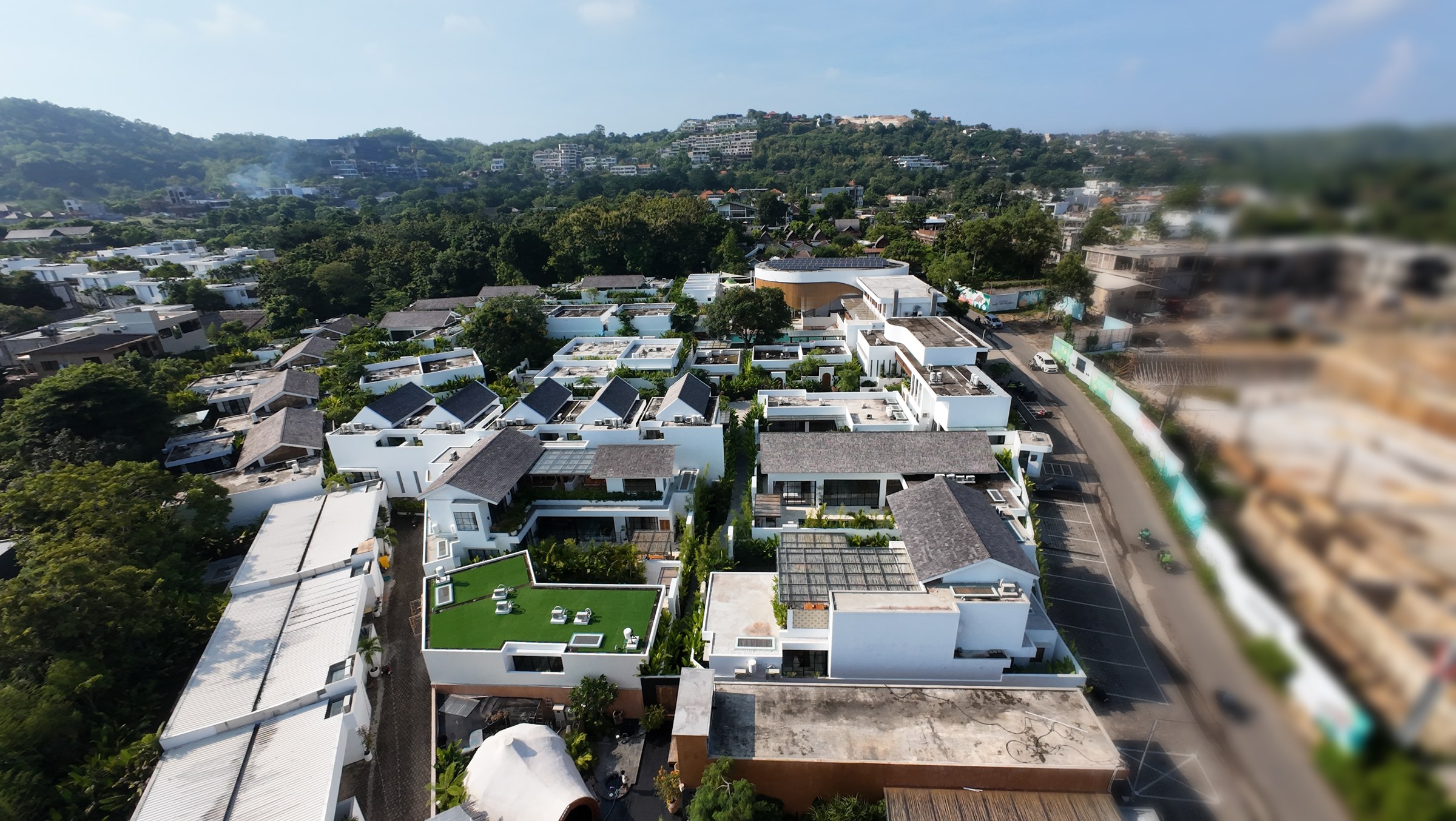
TAS.AC designed the audio system for PGD Aparthotel, an 85-unit, 6,800 m² apart-hotel in Berawa, Canggu, 700 m from the beach: 11 DSP zones with 51 loudspeakers on 32 amplifier channels, all fed from one Allen & Heath AHM32 matrix in a basement rack. Five DJ input points route any source to any zone group. Installation is under way; launch is planned for Q4 2026.
Ten of the eleven zones are routine work — coverage modelled, kit matched to the room. The eleventh, the open rooftop lounge, demanded a real decision.
How do you get even sound on an open rooftop lounge?
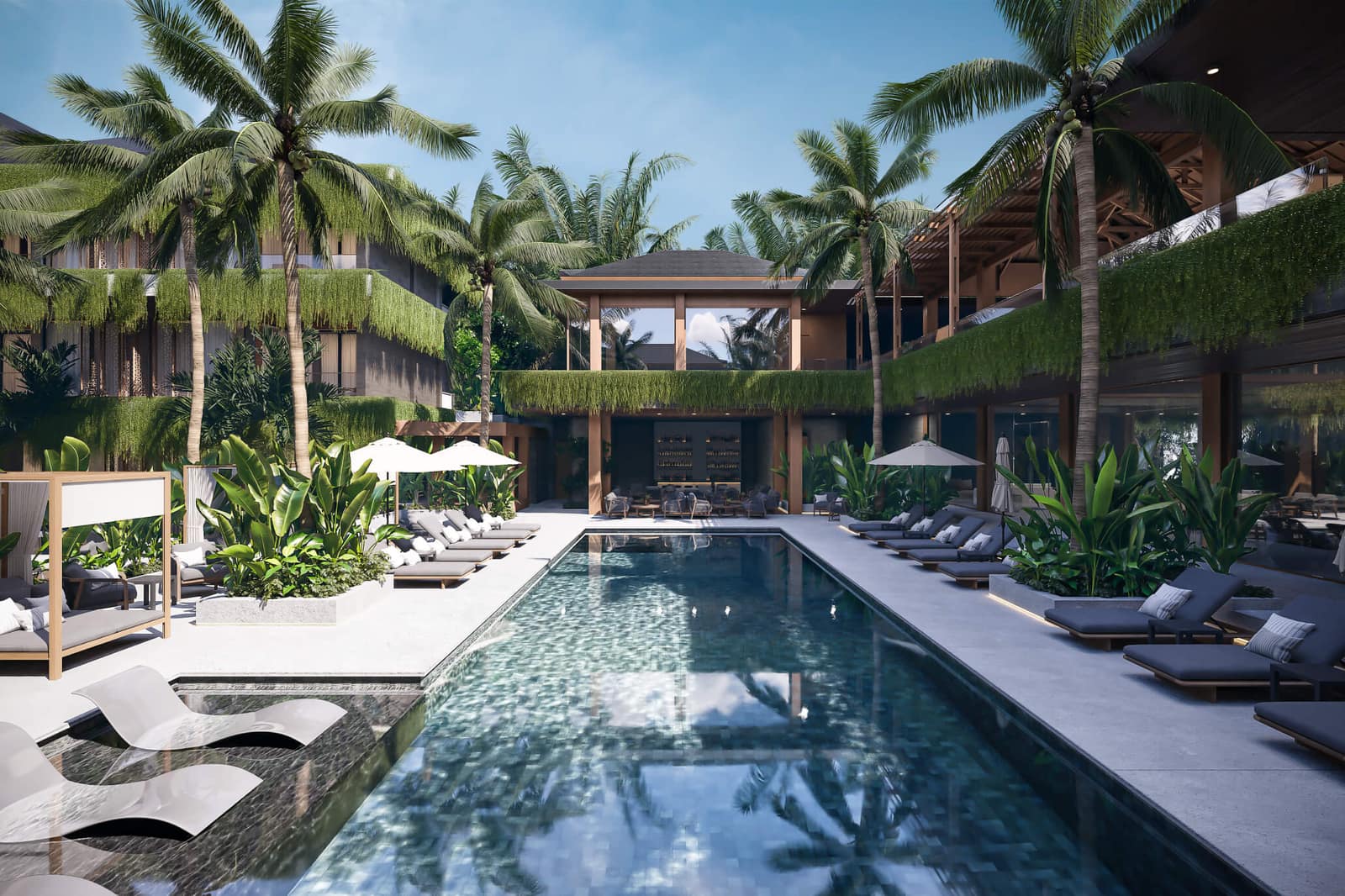
By distributing many small sources instead of driving a few loud ones. The PGD rooftop lounge has no walls and no ceiling, so nothing returns sound to the far seats — only the direct path counts, and it falls off fast with distance. TAS placed 10 mini-columns among the seating and recessed 3 horn-loaded subwoofers into the landscape: level comes from proximity, not power.
A pair of loud cabinets covering that span would burn the nearest tables, fade at the far rail and pour the excess over the parapet. Each TAS WT204 — a 2×4″ neodymium column, IP65-rated, 126 × 133 × 222 mm — covers the guests around it instead. No listener sits far from a source; no source has to shout.
The wiring is part of the design. The columns run in pairs, two per amplifier channel — a 2 Ω load the DX4035 amplifiers are specified to run — five channels for ten cabinets. The three JBL GSB8 subwoofers, 17.7 kg of horn-loaded cabinet each, sit in the landscaping on their own 2.5 mm² lines. The low end rises out of the planting; nothing black stands on a tripod.
None of it is placed by eye. Every zone is modelled in EASE Focus 3 on the manufacturers’ GLL data — outdoor zones computed at 30–32 °C and 60 % humidity — to ±4.5 dB coverage at working levels of 58–80 dB by zone.
How does the DJ system work across a Canggu hotel?
Any source can play to any zone or group. Five stereo DJ points in IP67 wall boxes — two at the rooftop bar, one each at the pool, the hookah lounge and the restaurant — feed a Behringer XR12 into the AHM32 matrix. A rooftop set routes to pool and restaurant together while the lobby holds its own feed, and the switch between background and event mode happens without restart or a second of silence.
Hotel staff run it themselves. Three user screens built on AHM Editor expose zone linking and source choice — and nothing that can undo the tuning. Underneath, every channel carries its own crossover, PEQ, delay and limiter in DSP. The tuning survives the operators.
Why design-phase integration?
Speaker positions, cable routes and the rack location land on the architectural drawings, not on a punch list after handover. TAS.AC works alongside SHOVK Studio (Kyiv) and 19 Buro / AV19 Bureau (Bali), so conduit and back-boxes are placed correctly the first time, and amplifier heat and noise sit in the basement rack room, away from guest spaces — instead of being fought against a finished ceiling.
Eleven zones from one basement rack
The whole building plays from a 27U basement rack: sources into the AHM32 32×32 matrix, zone processing in two TAS DS1616 units, then eight DX4035 four-channel amplifiers — 32 channels for 51 loudspeakers. Three WiiM Pro Plus streamers and four Geekom A5 players feed the scheduled daytime background, all on an isolated VLAN.
Power keeps the same order: the eight amplifiers split across two smart PDUs, four on each, starting in sequence 2–3 seconds apart. The rack never hits the line at once. A fire-panel dry contact mutes every zone with absolute priority and releases only after the panel resets. Voice evacuation is a separate system; the mute clears its path.
The eleven zones — reference
| Zone | Loudspeakers (design) | Day / event role |
|---|---|---|
| Lobby | 3× Tannoy DVS 6 | Ambient · holds its own feed during events |
| Co-working | 4× Tannoy SAT 3 + 1× Tannoy SAT SUB | Low ambient · independent or muted |
| Restaurant + bar | 4× Tannoy DVS 6 + 2× Tannoy SAT SUB | Dining · joins the DJ group, own DJ point |
| Pool | 3× JBL Control 85M in-ground, IP65 | Ambient · joins the rooftop group, own DJ point |
| Rooftop bar | 3× TAS MT-8 + 1× TAS S10B | Ambient · primary DJ origin, 2 DJ points |
| Rooftop lounge | 10× TAS WT204, IP65 + 3× JBL GSB8 in-ground | Ambient · joins the rooftop group |
| Rooftop hookah | 2× TAS MT-8 + 2× TAS S10B | Ambient · own DJ point |
| Rooftop toilet | 1× TAS PRO-108D | Low ambient · independent |
| Ground-floor toilet | 1× TAS PRO-108D | Low ambient · independent |
| SPA treatment + reception | 3× Tannoy CMS 603DC BM + 4× Tannoy SAT 3 + 2× TAS MT-8 | SPA program · stays off the event bus |
| SPA salt room | 2× TAS DSP6060B wall-mount, IP66 | SPA program · stays off the event bus |
Head end: Allen & Heath AHM32 · 2× TAS DS1616 · 8× TAS DX4035 · Behringer XR12 · 3× WiiM Pro Plus · 4× Geekom A5 · TP-Link TL-SG2218 · 2× smart PDU, sequenced start · 27U Indorack. Speaker lines: WC 2×1.4 on the ground floor, Kitani Nymphy 2×1.5 to pool, SPA and rooftop, 2×2.5 to the rooftop subwoofers.
What does an 11-zone hotel sound system cost?
There is no published total for PGD Aparthotel; TAS.AC prices by scope — see how we price. These factors move the number more than floor area does.
| Cost driver | Why it moves the price at a venue like PGD Aparthotel |
|---|---|
| Zone count | 11 independent zones mean more amplifier channels, more DSP I/O and more cable runs than a single-zone bar |
| Routing complexity | An any-to-any DJ matrix with gapless mode-switching needs a real matrix processor, not background-music gear |
| Speaker tier and weather rating | Rooftop and pool event coverage takes higher-output, IP-rated units, and salt air in Berawa pushes exposed zones toward corrosion-resistant hardware |
| Control and integration | Staff-operable control, scheduling, fire-alarm priority and remote management add head-end cost beyond raw audio |
Where the project stands
Installation is under way; launch is planned for Q4 2026. Public listings cite the developer under more than one legal name; this page describes only the audio scope TAS.AC delivers. Nothing on this page has been measured in the finished building. The EASE targets — working levels of 58–80 dB by zone, ±4.5 dB coverage uniformity — and the routing behavior are the yardstick the commissioned system will be tuned and accepted against.