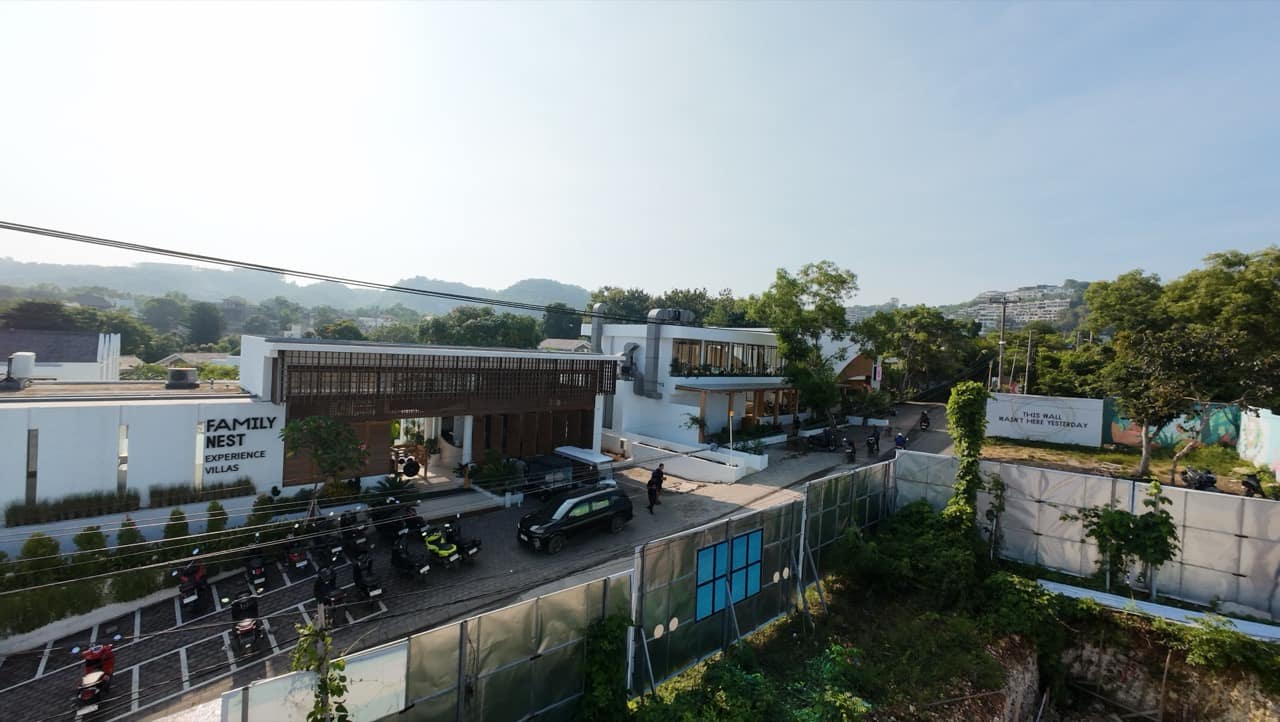
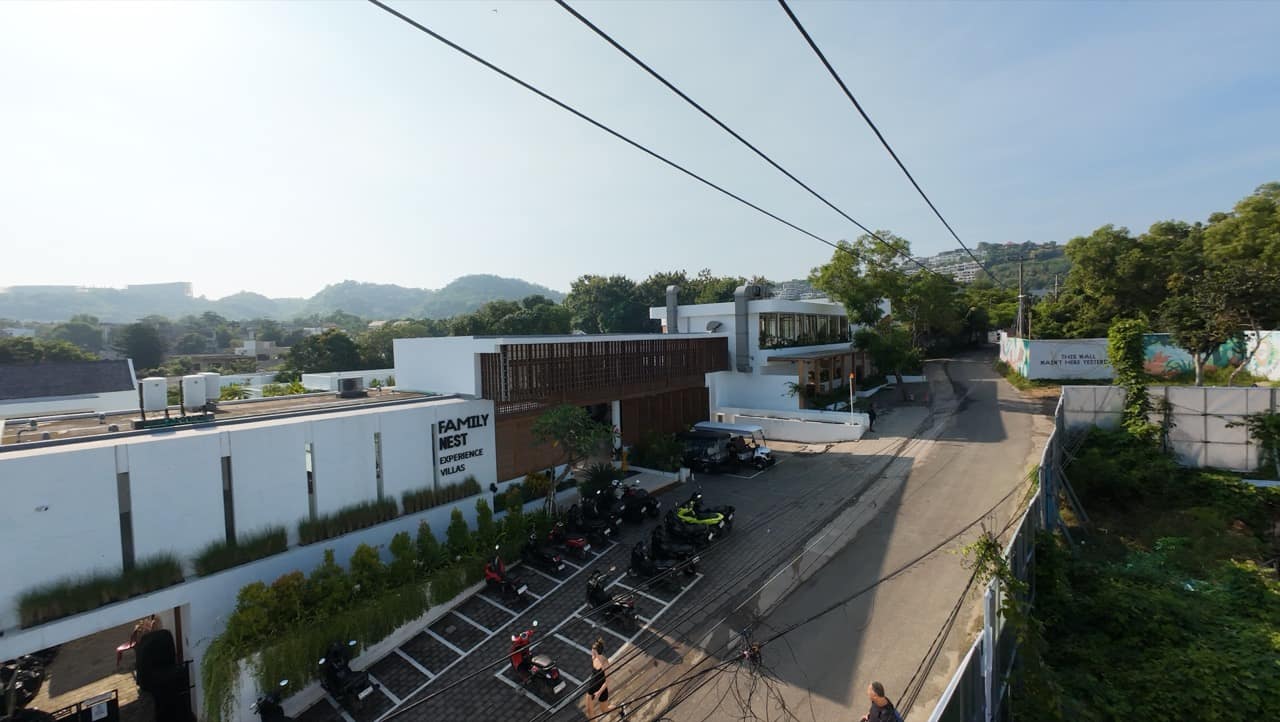
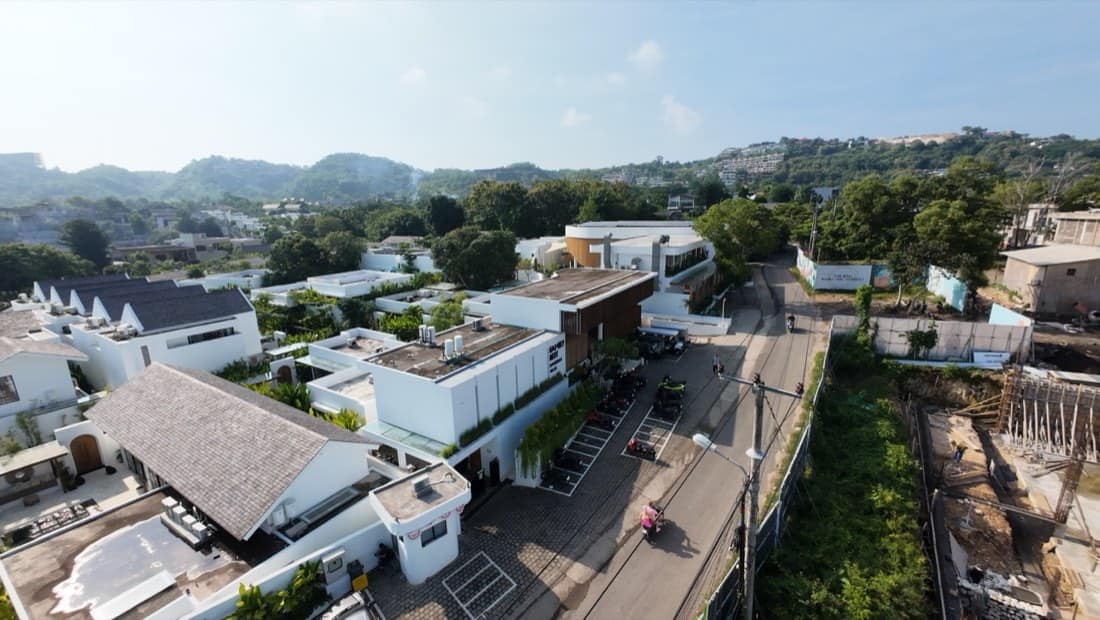
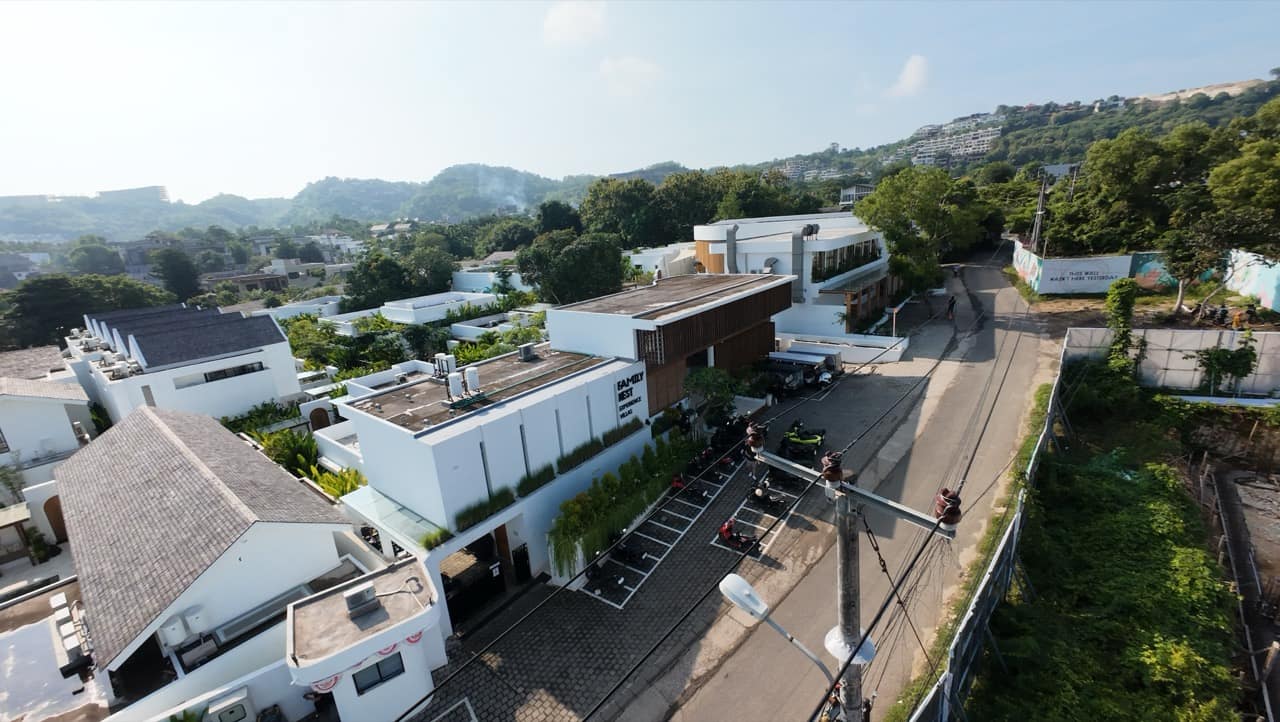
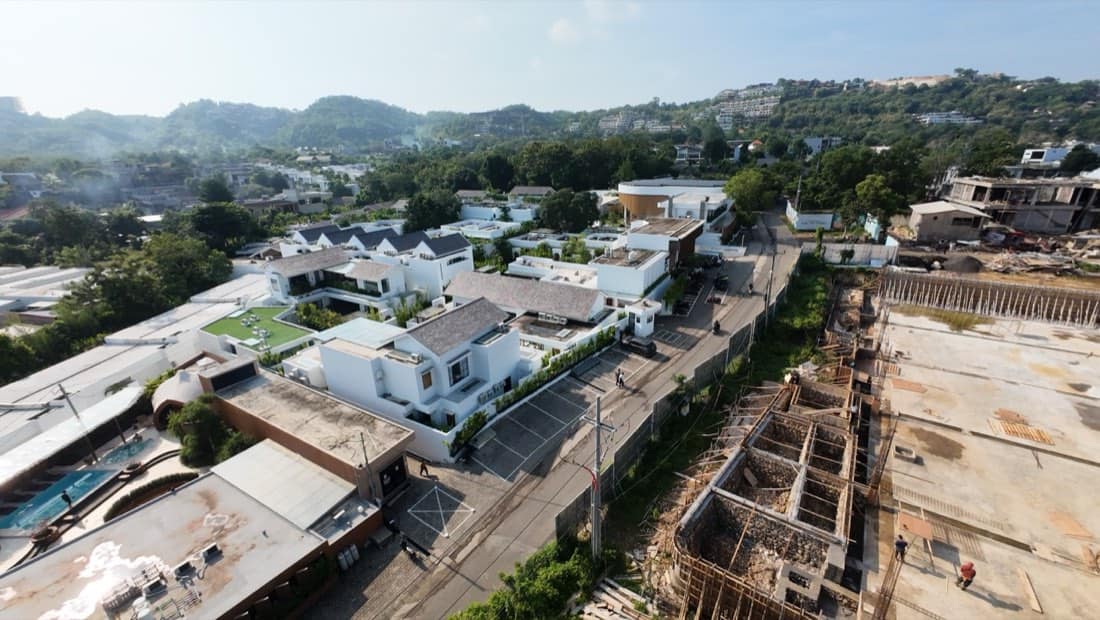
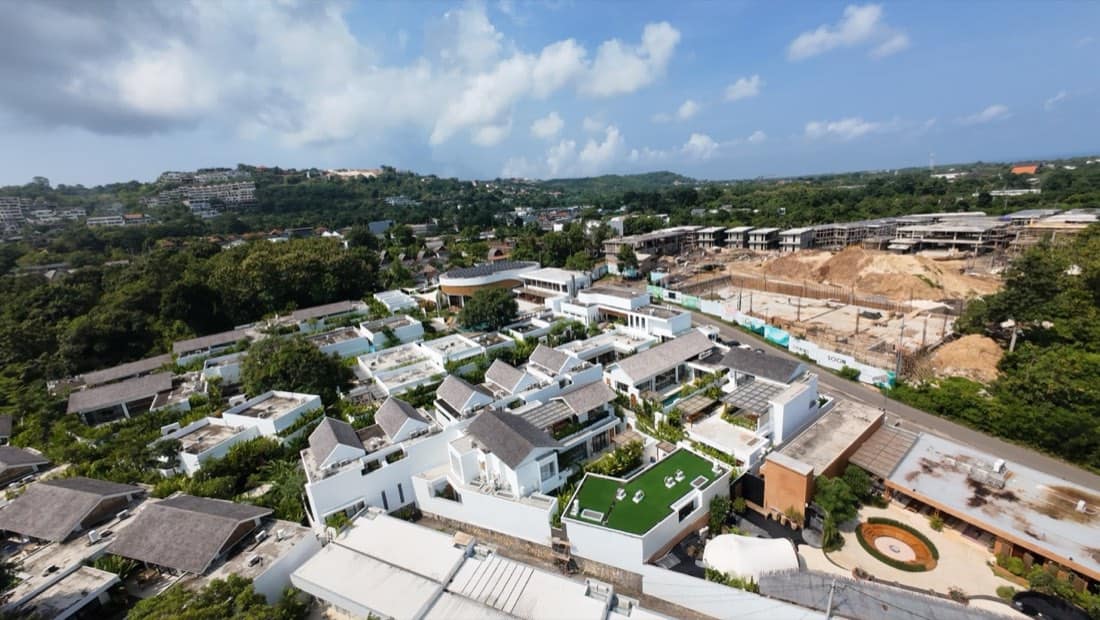
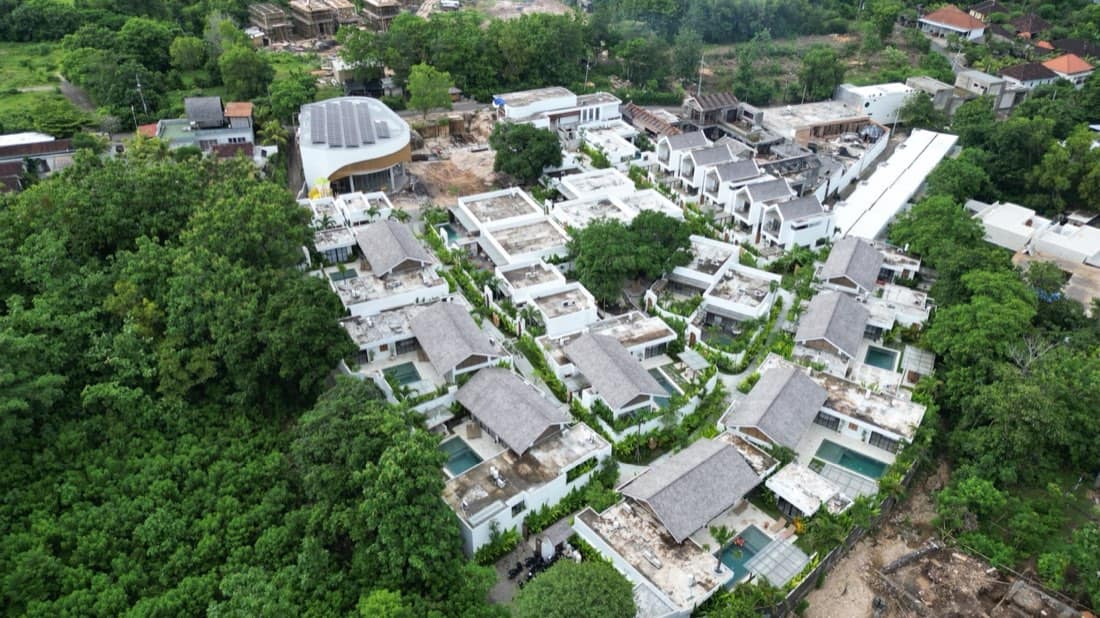
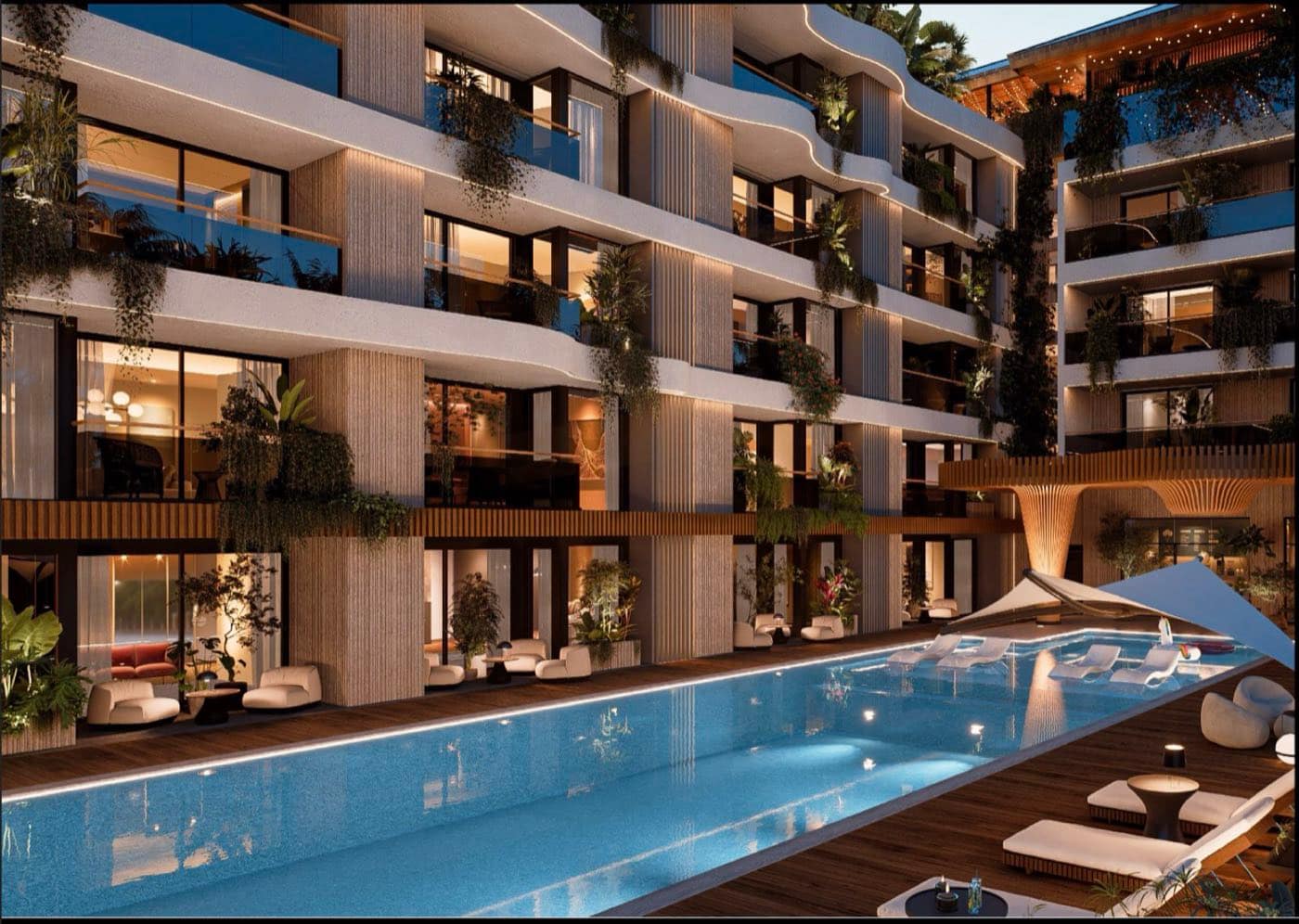
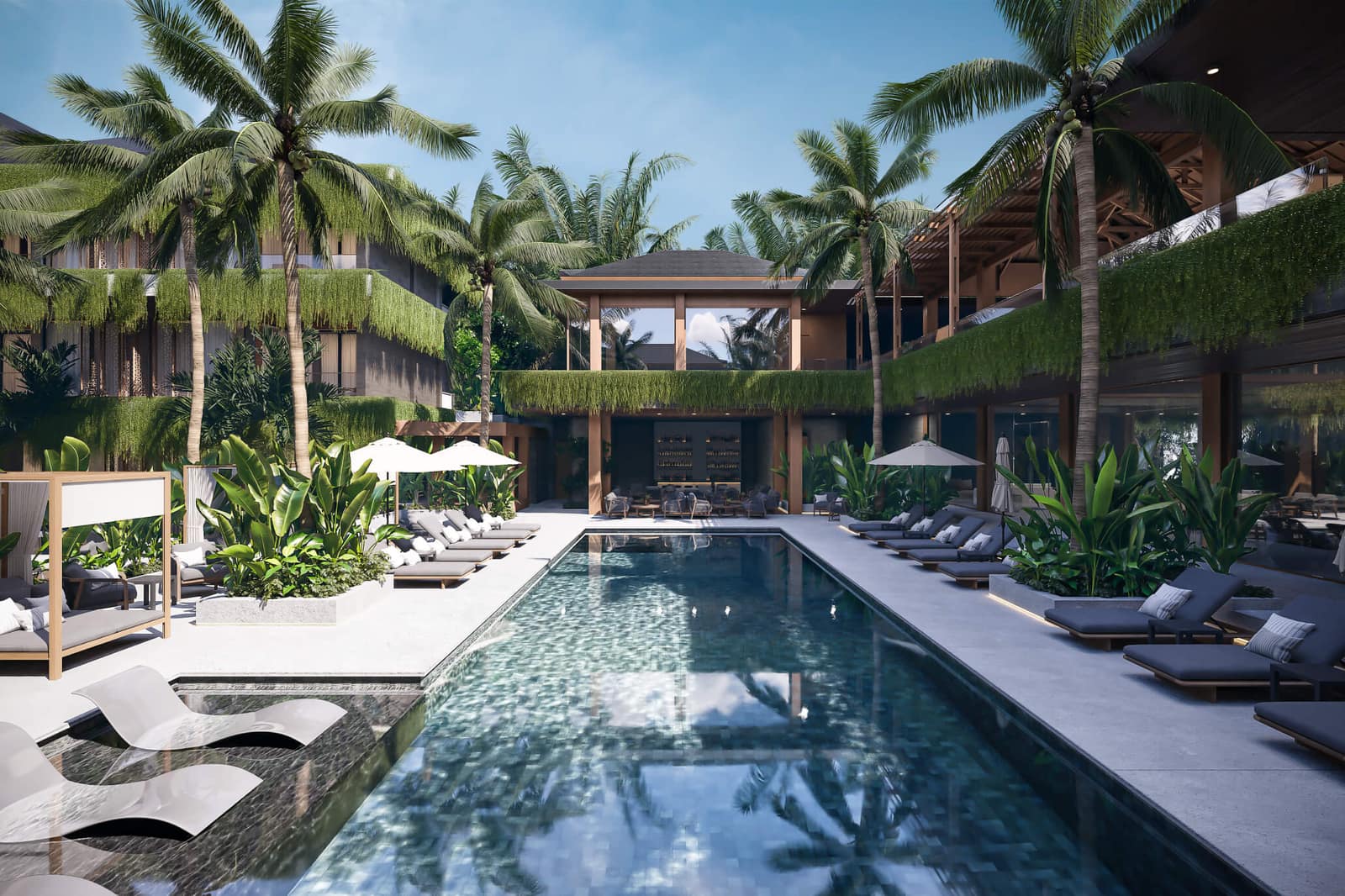
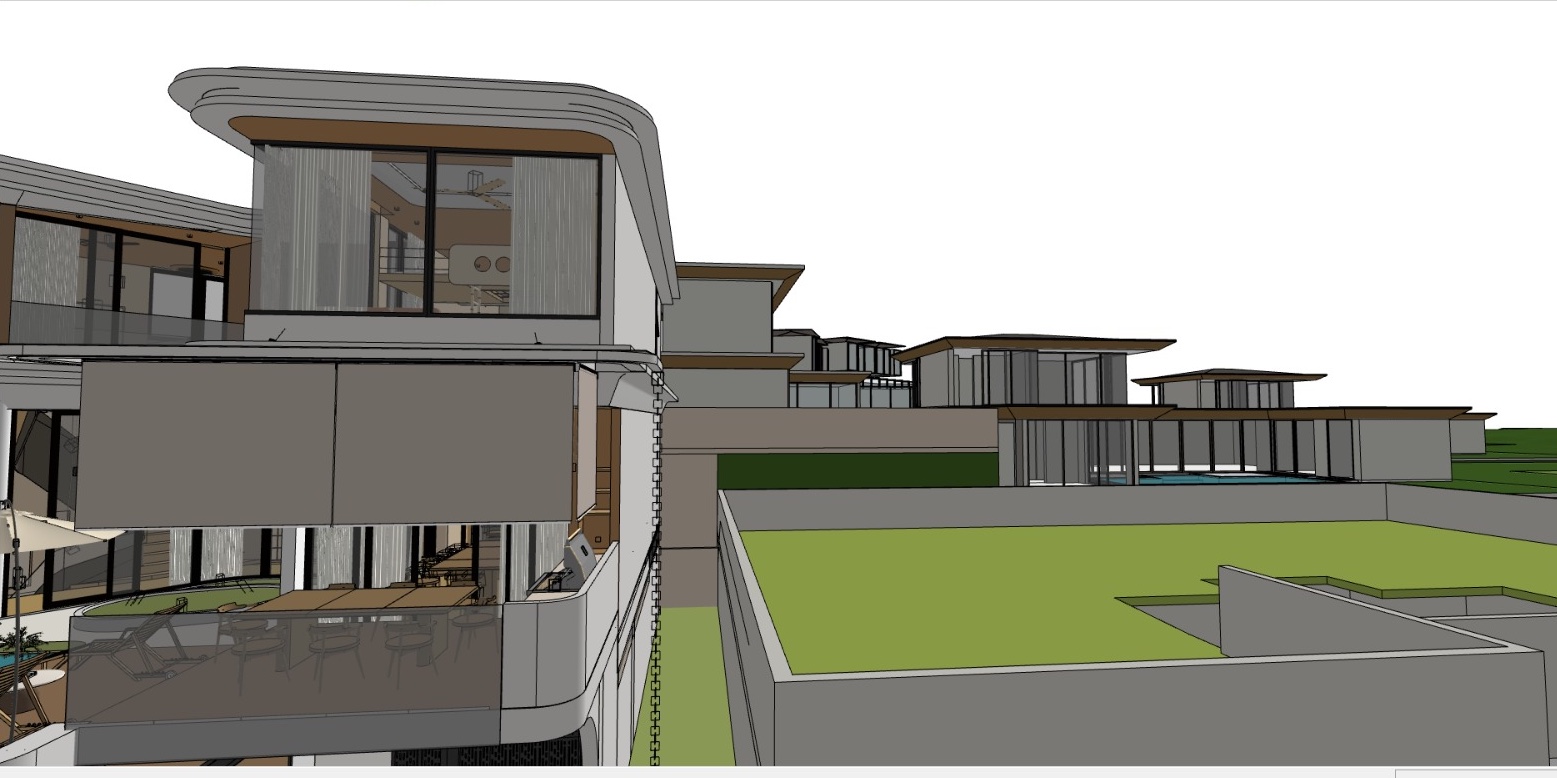
Family Nest — family resort, Pecatu, Uluwatu, Bali. Four venues and 34 villas on one physical backbone: 23 audio zones, 59 cameras, 100 access points, dual-WAN Starlink failover. Role: TAS.AC — the entire low-voltage scope under one contract: network, audio, CCTV, access, control. Key figures: $200/month connectivity for the whole property · 712 GB carried per day (July 2026) · Phase 2 re-engaged on the same backbone. Status: Phase 1 operational; Phase 2 in construction. Snapshot figures are operating numbers, dated July 2026.
A guest at Family Nest starts music in the villa, walks to the pool, and sits down at the restaurant with the playlist still playing. The walk crosses three spaces and one property-wide Wi-Fi network; the AirPlay stream never changes hands. The resort reads as one place because one infrastructure carries all of it — unseen.
The owner sees two things. Connectivity for the entire property — four venues, 34 operational villas — is a single line of $200 a month. And when a zone drops at 9 pm, the fix starts with one WhatsApp message to the integrator, not a round of calls to establish whose cable it is.
What does “four venues, one contract” mean at Family Nest?
At Family Nest in Pecatu, Uluwatu, the developer engaged TAS.AC as the single integrator for the entire low-voltage scope: network, audio, CCTV, access and control across the resort villas, Pangolin Kids Club, ATMOS Social Steam Club and Ants Pants Restaurant. One physical backbone spans all four venues and the villas; one team answers for every system riding on it.
The venues have nothing in common operationally — a children’s activity center, a wellness steam club, an all-day restaurant, private-pool villas — yet a family crosses all of them in a single day. The systems have to follow the family, so they were designed as one stack. On the salt-exposed Bukit Peninsula, that meant fiber between buildings, sealed enclosures outdoors, and humidity-rated speakers where the steam runs.
How is the Family Nest network built?
The core is layered. A UniFi UDM SE gateway routes the estate on dual WAN — the fiber ISP plus Starlink, switching within seconds if the primary line drops. Beneath it, a 24-port SFP+ MikroTik layer aggregates the fiber runs from every building and villa zone. Beneath that, eight named UniFi PoE switches serve the venues: Kids, Lobby, Resto, Steam, Tree house, Security and the villa zones.
The same grain reaches the smallest corner. Villas connect over fiber; a compact eight-port switch in the villa zone adds the pool-gate cameras and two UniFi Access readers, so renters pass on issued keys. The Security switch cascades the perimeter cameras and carries Wi-Fi for the security post that now works as the back office.
Every camera on the property lands in one place: 59 tropical-rated units recording to a 4-bay UniFi NVR in the estate server room, configured for Indonesian PDP Law compliance. The backbone was sized to absorb Phase 2 without re-trenching.
How are 23 audio zones controlled at Family Nest?
Audio shares the same backbone. ATMOS runs its own 8-zone Dante domain — the clay steam domes are an acoustic world of their own — while the remaining 15 zones form the estate loop across villas and common areas, Pangolin and Ants Pants. Fiber feeds the loop as a star from the master rack: 90 and 125 meters to the two street racks, 100 meters to the lobby, per the working drawings.
The villa side was designed street by street — two street runs, the pool, the tree houses, the lobby — then handed to operations as the three controls staff actually use: street, tree houses, lobby. The wiring keeps the fine grain; the interface drops it. The pattern was proven at ATMOS first.
Each venue holds its own case: Pangolin Kids Club — interactive play, the 7.2 cinema with its 4.5 m screen, and the estate’s core rack in its basement; ATMOS Social Steam Club — eight Dante zones inside the steam domes; Ants Pants Restaurant — five estate-loop zones on the venue’s own rack, joined by one Dante link. The same contract carries the atmospheric lighting across the venues and the unified app control over all of it.
The Family Nest system — reference
Controller data from the live Family Nest network, July 2026. These are operating numbers, not design targets — they move day to day and are dated accordingly.
| Layer | In operation — July 2026 |
|---|---|
| Gateway | 1 UniFi UDM SE, dual-WAN live: fiber ISP plus Starlink, both links up, automatic failover |
| Switching | 8 UniFi access switches behind the MikroTik fiber-aggregation layer |
| Wi-Fi | 100 access points across the estate; 382 client devices online at the snapshot, peaks above 300 concurrent clients at 15–17% airtime utilization — headroom, not saturation |
| Traffic | 712 GB per day (590.78 GB down, 121.7 GB up) |
| Audio | 23 zones — ATMOS’s own 8-zone Dante domain, heat/humidity-rated speakers in the clay steam domes; 15-zone estate loop: dining and DJ routing, cinema and play spaces, background music across pool and gardens |
| CCTV | 59 cameras on the same backbone |
How much does resort AV infrastructure cost in Bali?
Cost scales with venue count, audio zone count, equipment grade and how much of the build is tropical-rated; a four-venue, 23-zone property sits well above a single-villa system. TAS.AC publishes cost drivers and ranges, not invented totals — see how our pricing works. Every installation carries a two-year TAS.AC warranty. For a resort, the decisive number is rarely the install price — it is the operating cost the network architecture locks in for years.
The original plan was the Bali default: a separate ISP contract for each villa and venue, $1,046 a month in Phase 1. TAS.AC proposed and built the centralized fiber backbone instead — one ISP line plus Starlink failover, $200 a month for the whole property: $846 saved monthly. On the Phase 1+2 projection of 45 villas, savings rise to $1,055 a month, $12,660 a year.
Monthly operating cost (Phase 1, 34 villas)
| Model | Breakdown | Monthly | Annual |
|---|---|---|---|
| Separate ISP per object | 34 villas × $19 + 4 venues × $100 | $1,046/mo | $12,552/yr |
| TAS.AC centralized backbone | 1 ISP ($100) + 1 Starlink failover ($100) | $200/mo | $2,400/yr |
| Savings | $846/mo | $10,152/yr |
Phase 1+2 projection (45 villas)
| Model | Breakdown | Monthly | Annual |
|---|---|---|---|
| Separate plan | 45 villas × $19 + 4 venues × $100 | $1,255/mo | $15,060/yr |
| TAS.AC centralized (same backbone) | Still $100 ISP + $100 Starlink | $200/mo | $2,400/yr |
| Savings | $1,055/mo | $12,660/yr |
Phase 2 takes the projection to 45 villas at $0 in new ISP cost; the separate model would add $209 a month. The centralized network also collapses dozens of ISP accounts, routers and invoices into one managed dashboard, and turns a drive to the villa into a remote fix. The roaming — the playlist that survives the walk from villa to restaurant — is impossible across dozens of separate router setups; it depends on this backbone entirely. Figures are TAS.AC project estimates based on the as-built scope.
What were the results?
Phase 1 is operational, and the developer re-engaged TAS.AC for Phase 2 — the model held up well enough to be bought twice. Phase 2 plugs into the existing fiber at no new ISP cost. Family Nest was named an International Property Awards 2026 winner; it holds a public 5.0/5 across 29 TripAdvisor reviews as of July 2026.